

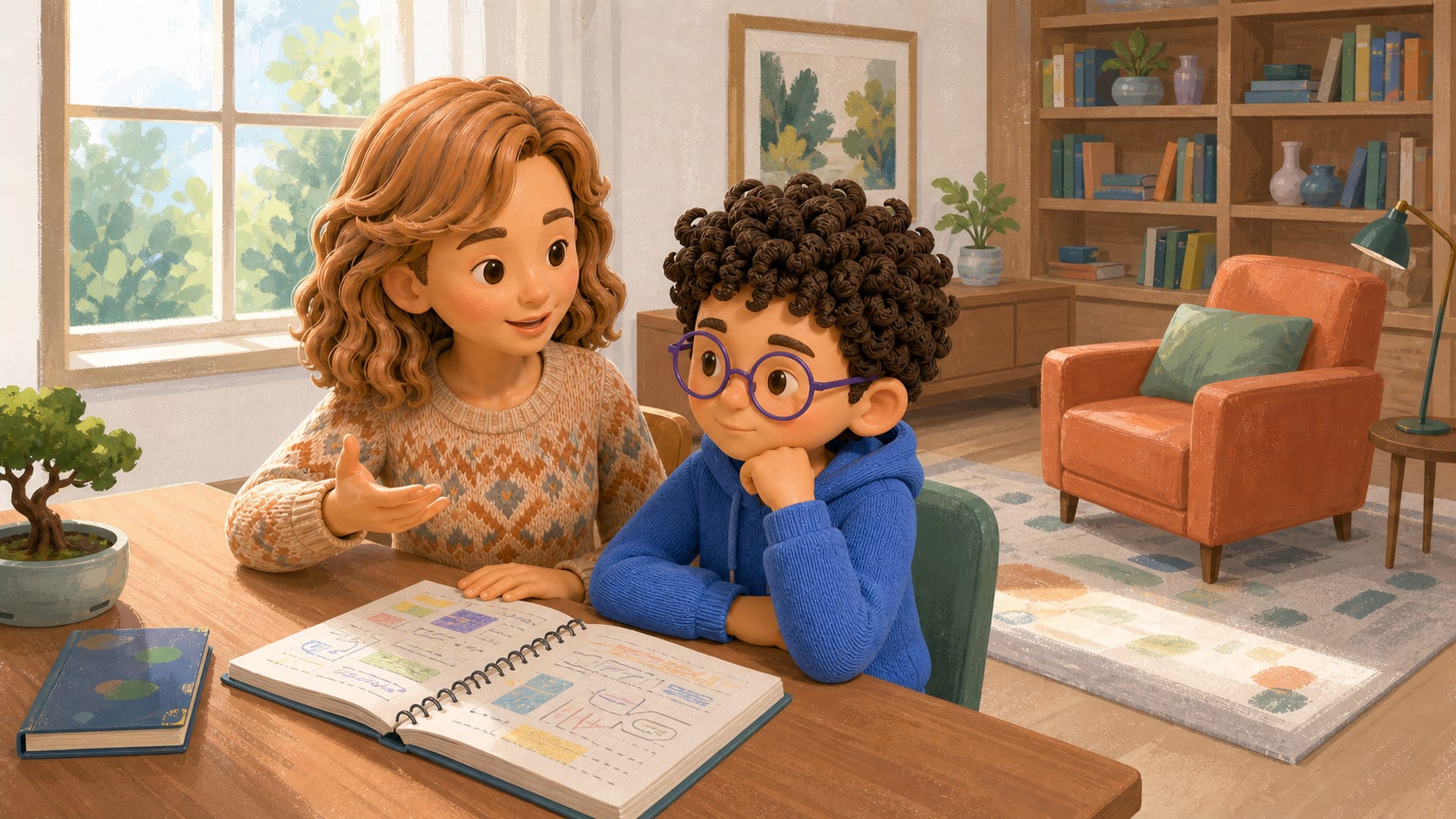
There’s a moment most parents are familiar with. Your child is stuck on a maths problem.You sit down to try and explain it the way it was explained to you when you were in school. But your child just stares at you with a blank look on his face.
So you try explaining it again. This time a bit slower and using a different example. All of a sudden something clicks. It instantly makes sense. You look at each other and neither of you is entirely sure what just happened.
What happened is that the explanation finally matched the way your child was thinking about the problem.
Practice helps, but only after a concept is understood
When a child struggles with a maths concept, the most common response is to give them more of it. Repetition and practice will solve it.
For some children, this can certainly work. They may be at a phase of learning where they just need practice and repetition. But for others, practicing a concept they don’t fully understand yet can only build frustration. Even if they answer questions correctly, it may simply be they are good at guessing and just trying to push through without really understanding the concept.
Practice is still an important part of learning. It can strengthen understanding that has already formed. But practice cannot build understanding if a child cannot grasp the concept in the first place.
If two children both get a question wrong, the reasons why can be different. One may be relying on a rule that only works when a question is asked a certain way. Another may have understood the concept, but struggle to recognise how it applies when the problem is framed differently.
A different explanation
Most parents have seen the moment when something finally clicks. When the same problem is reframed, it suddenly all makes sense. A slice of pizza as opposed to a fraction on a number line. Or multiplication groups instead of times tables.
This isn’t some miracle. The way something is taught can have a profound impact on how effectively a child learns. The maths concept didn’t change. It’s the framing that made the difference.
This is one part of learning that is hardest to see and deliver. Classrooms move at one speed. It is too difficult for a teacher to personalise the same example to every single child in the classroom. This isn’t a failure of teachers or schools. But it is the reality of how most learning has always been delivered.
The dimensions of ‘levels’ versus ‘framing’
When the concept of personalised learning is discussed, it usually revolves around the level of difficulty. Some children need more advanced work while others help getting the basics right. It’s like having a more advanced class for some children, or a more intermediate class that needs more time spent on the basics.
The level of difficulty matters but this is only one dimension. Two children can be at the same difficulty level and be given the same explanation of a maths concept. One might understand it while the other doesn’t. What’s happening here is that each child has a different approach to how they learn. For learning to register, some children need to see it visually, others need to hear it, while others might just need to learn by doing.
In learning, adjusting for the level of difficulty is useful, and many learning tools can do just that. But moving a child up or down the ‘difficulty ladder’ does not change the impact that framing the explanation has. A child can be on the right difficulty level, but what needs to change or adjust is how the concept is explained to them.
The impact on children
When a child is given the same explanation over and over and still does not understand, it’s rarely thought that maybe it’s the explanation that didn’t suit them. The child and/or the parent might just think: “I am just not good at this”.
That is the true impact and cost in treating every child the same. It’s not just slower progress. It’s the loss in confidence from working at something and not being able to see why the concept is not sinking in.
Confidence in maths is built slowly over time. It can be lost just as easily. And often it’s in situations where a child just needed a different way in, as opposed to more of the same.
Learning that adapts to the child
The good news is that one-size-fits learning doesn’t have to be the case forever. The future of learning isn’t just about repetition and spending more hours at the desk with more questions and more content. It’s learning that can respond more thoughtfully to the child and in a more personalised way.
Sometimes a child doesn’t need the content repeated over and over. They just need it to be delivered from a different perspective.
Every child leans differently and this isn’t new. What is changing is the possibility that learning can finally give them a different way in.
We’re building Brainiac, an adaptive learning platform that helps your child learn maths at the right level, with lessons that adjust as they progress.
Join the waitlist and be notified when we launch.